
Timed drills are a classroom classic, and some kids love racing the clock. Many don't. A child who knows that 6 × 4 is 24 can still go blank when a timer is ticking, and a few bad experiences can turn into "I'm just bad at math." The real goal is for your child to know their facts so well that answers come quickly on their own. That's called fluency, and it grows best through calm, regular practice. This guide explains what fluency means, what researchers say about timed tests, and a simple 10-minute routine you can use at home.
What math fluency really means
Fluency isn't the same as speed. Teachers usually describe it as three things together:
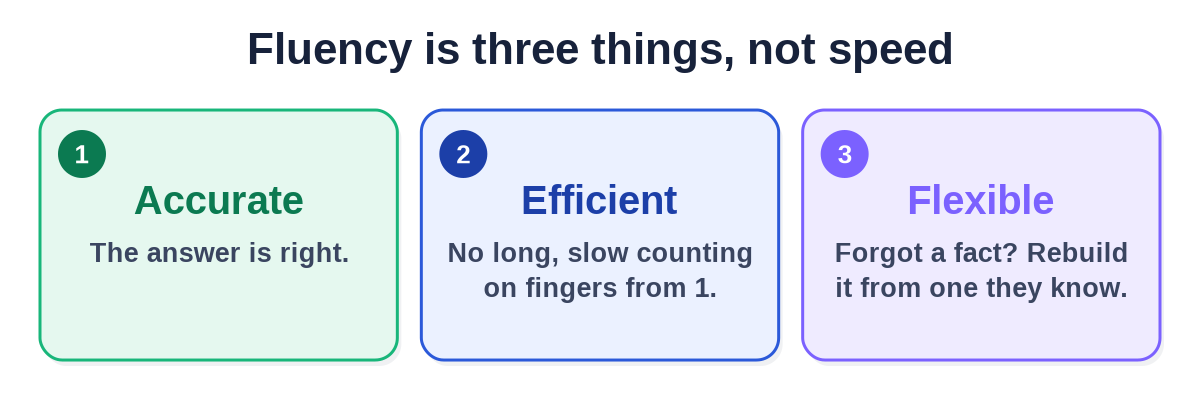
- Accurate: the answer is right.
- Efficient: your child gets there without a long, slow method like counting on fingers from 1.
- Flexible: if they forget a fact, they can rebuild it from one they know.
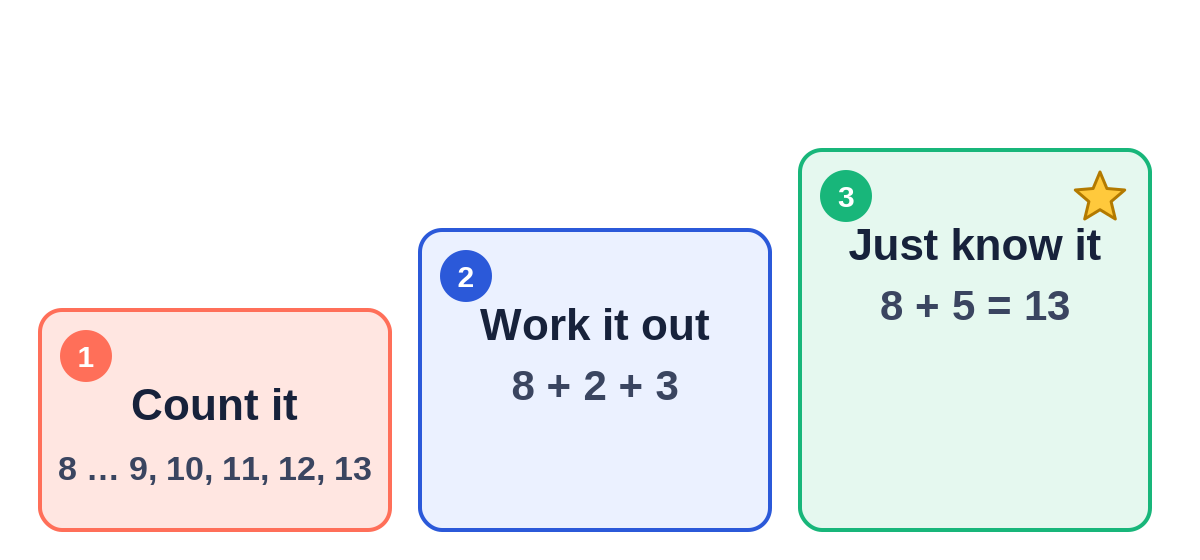
Most children move through three stages with each group of facts. First they count. Then they use strategies, like "8 + 5 is 8 + 2 + 3." Finally they just know it. Speed shows up naturally in that last stage.
What research says about timed tests
Researchers don't fully agree here, and it's worth knowing both sides.
Stanford math education professor Jo Boaler has argued for years that speed pressure and timed tests can trigger math anxiety, even in children who know their facts. Her paper Fluency Without Fear recommends learning facts through number sense, visual work and games instead of speed drills. Stanford's summary of the paper notes her point that strong math students aren't necessarily fast ones.
On the other side, a 2021 practice guide from the U.S. Department of Education's What Works Clearinghouse, written for teachers helping elementary students who struggle with math, rates the evidence for short timed activities as strong. But look closely at how it says to use them:
- Activities last only about 1 to 5 minutes.
- They come after a child already has an efficient strategy, never to introduce something new.
- Accuracy is the goal, not how many problems get done.
- Children try to beat their own earlier score, and progress charts stay private.
Put the two together and a clear middle path appears: build understanding and strategies first, keep practice short and low-pressure, and if you use a clock at all, make it a private "beat your own best" game once your child is already accurate. That's the approach in the rest of this guide.
Why speed comes on its own
When a fact is truly familiar, your child doesn't have to work it out. They just know it, and knowing is fast. So the thing to build is familiarity, and familiarity comes from seeing a fact many times over many days. A few minutes a day does more than one long, tense session on Sunday night, because the brain needs time between practice sessions to make facts stick.
A calm 10-minute routine
Here is a routine that fits before dinner or after a snack. It works for addition facts, times tables or division.
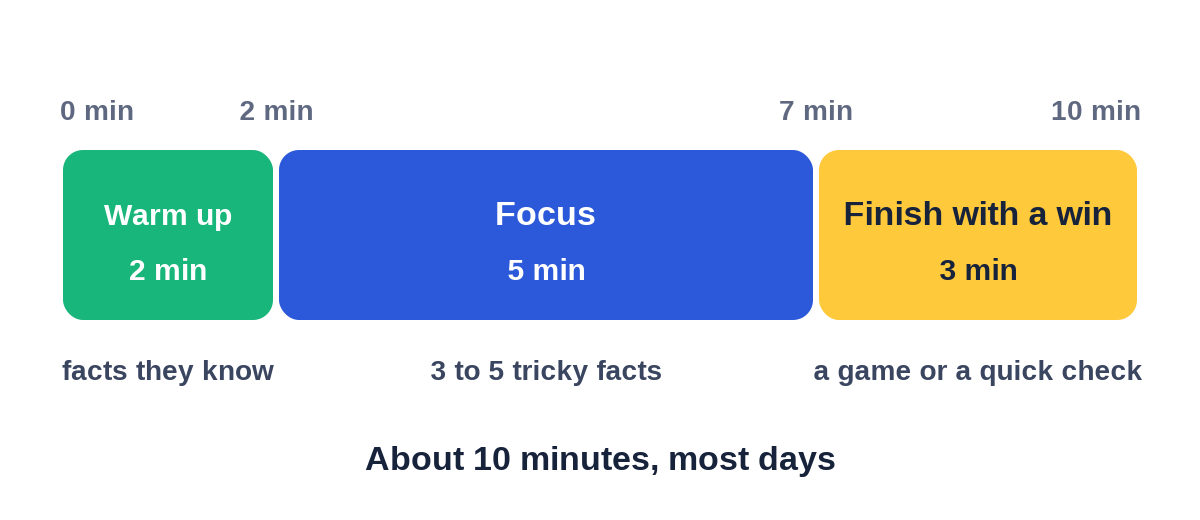
- Warm up (2 minutes). Start with facts your child already knows. It gets them going and builds confidence.
- Focus (5 minutes). Pick just 3 to 5 tricky facts. Talk through a strategy for each one, then practice them mixed with a few known facts.
- Finish with a win (3 minutes). A short game, a few problems online, or flipping through cards they know. Stop while it's still going well.
Sort facts into three piles
Flash cards work much better when you sort them. Make three piles: "I just know it," "I can work it out" and "Not yet." Each day, practice mostly from the middle and last piles, and move cards forward as they get easier.
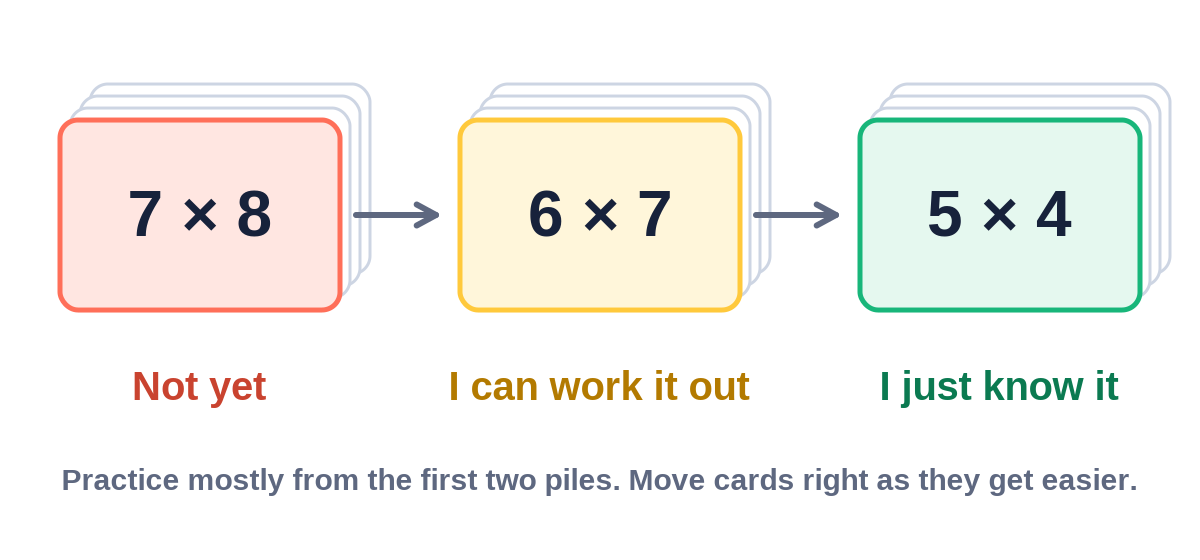
Watching cards move into the "I just know it" pile is motivating in a way a stopwatch never is. Your child can see their progress.
Five calm ways to practice
- Short and often. Five to ten minutes, most days. Consistency matters more than length.
- Say it out loud. Hearing and saying facts helps them stick. Read problems aloud together, or let your child answer by voice.
- Bring back the tricky ones. Spend more time on facts your child misses and less on the ones they already know.
- Praise effort and progress. "You got 7 × 8 today and you didn't last week" means more than any score.
- Let them check their own work. An answer key or instant feedback turns mistakes into practice instead of failures.
Strategies beat memorizing alone
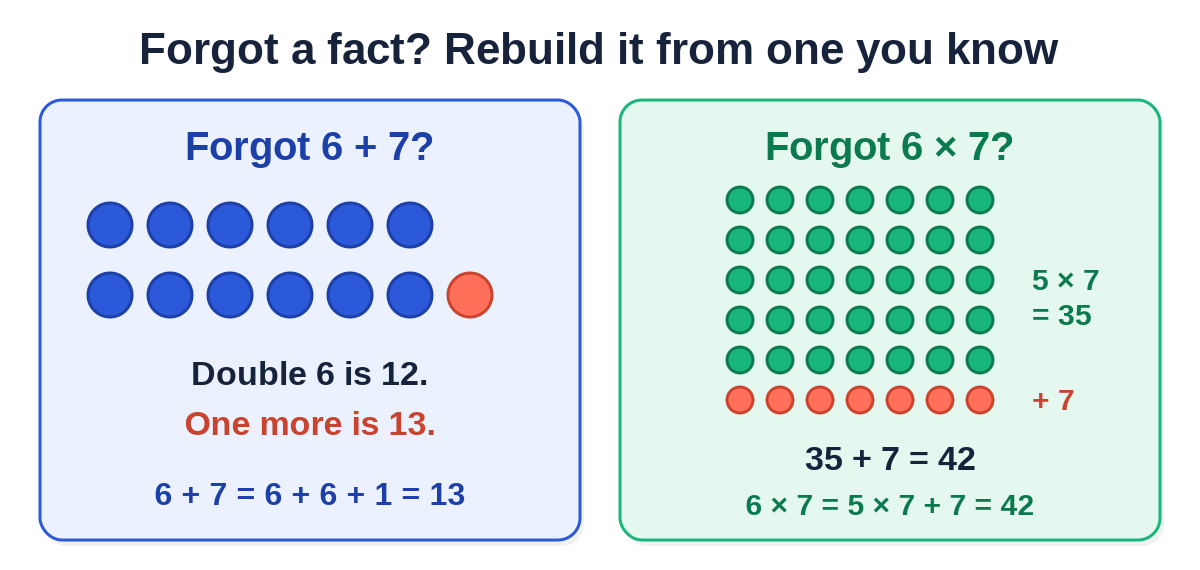
A strategy is a way to rebuild a fact from one you already know. Children who have a few strategies don't panic when a fact slips their mind. Some of the most useful:
| Strategy | Example | Learn more |
|---|---|---|
| Make 10 | 8 + 5 = 8 + 2 + 3 = 13 | How to teach make 10 |
| Doubles plus one | 6 + 7 = 6 + 6 + 1 = 13 | Doubles practice |
| Use a 10 | 9 + 6 = 10 + 6 − 1 = 15 | Addition within 20 |
| Five groups plus one more | 6 × 7 = 5 × 7 + 7 = 42 | Times tables order |
| Double a double | 4 × 8 = double 2 × 8 = 32 | Multiplication facts |
| Think multiplication | 42 ÷ 6: 6 × 7 = 42, so 7 | Fact families |
How our practice pages handle time
We built the site around calm practice. Our online worksheets, like Addition within 10 and Multiplication facts to 10 × 10, have no timer at all: just stars for right answers, a hint on every problem and a "Show me how" button when your child is stuck. Each visit makes a new set, so there's always fresh practice.
Our read-aloud times tables practice reads each problem out loud, lets your child answer by voice or by tapping, and quietly brings back the facts they find tricky. The clock is hidden by default. If your child enjoys beating their own time, a grown-up can turn it on under "For grown-ups."
When a timer can help
Once your child's facts are accurate, some kids enjoy a friendly challenge. If you try one, keep it in the spirit of the research above:
- Keep it short, a minute or two.
- Race your own best time, never a sibling's or a classmate's.
- Count right answers, not how many problems got done.
- Watch your child's face. If it looks like fun, keep it. If it looks like worry, put the clock away.
Signs of math anxiety, and what to do
Watch for stomachaches before math homework, tears or freezing on problems they can usually do, or comments like "I'm just not a math person." If you see these:
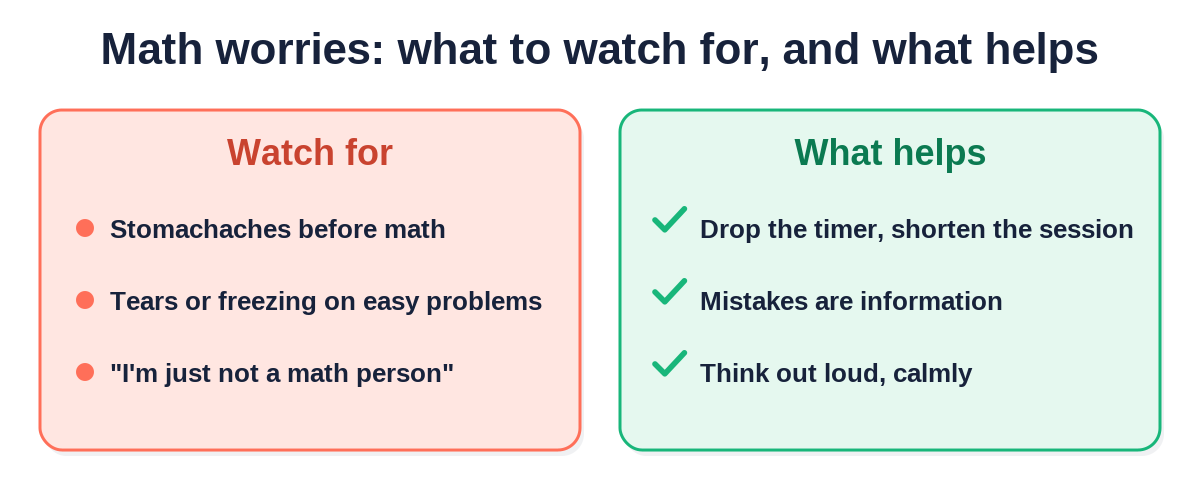
- Lower the stakes. Drop the timer, shorten the session and start with problems your child can do.
- Treat mistakes as information: "Interesting, let's see what happened there."
- Show calm thinking out loud: "Hmm, I need a second to work this one out."
- Try not to say "I was bad at math too," even as comfort. It can send the message that math ability is fixed or runs in the family.
- If worry keeps showing up at school, talk with your child's teacher. They may see it too and have ideas.
What fluency looks like in each grade
These are the fluency goals in the Common Core standards, with a free practice page for each:
| Grade | Fluency goal | Practice |
|---|---|---|
| Kindergarten | Add and subtract within 5 | Addition within 5 |
| Grade 1 | Add and subtract within 10 | Addition within 10 |
| Grade 2 | Add and subtract within 20; know sums of one-digit numbers by heart | Addition within 20 |
| Grade 3 | Multiply and divide within 100; know products of one-digit numbers by heart | Multiplication facts to 10 × 10 |
| Grade 4 | Add and subtract multi-digit numbers with the standard method | Multi-digit addition |
| Grade 5 | Multiply multi-digit numbers with the standard method | Three-digit by two-digit multiplication |
Questions parents ask
Are timed math tests bad for kids?
Not always, but they can be. Some researchers link timed tests to math anxiety, while a U.S. Department of Education practice guide supports very short timed activities when children already have a strategy, the goal is accuracy and kids compete only with their own past scores. At home, calm untimed practice is the safest place to start.
How fast should my child know their math facts?
A common rule of thumb is about three seconds: fast enough that your child isn't counting, but with time to think. More important than any number is that the answer comes without counting from the beginning.
What if my child's school uses timed tests?
Practice the facts calmly at home so they feel familiar, and talk with your child about doing their best rather than finishing everything. If the tests are causing real stress, let the teacher know. Many teachers are happy to adjust.
Are flash cards a good idea?
Yes, especially when you sort them into piles and focus on the tricky ones. Pair them with strategies so your child has a way to work out a fact they forget.
Sources and further reading
- Jo Boaler, Fluency Without Fear: Research Evidence on the Best Ways to Learn Math Facts, youcubed at Stanford University.
- Stanford News, Learn math without fear, Stanford expert says (2015).
- What Works Clearinghouse, Assisting Students Struggling with Mathematics: Intervention in the Elementary Grades (2021), Recommendation 6: Timed activities.
- Common Core State Standards: 2.OA.B.2 and 3.OA.C.7.


