
Your child knows that 12 − 5 is 7. But give them "Maya had some stickers. She got 5 more. Now she has 12. How many did she have at first?" and they freeze, or they add 12 and 5 and proudly write 17. Sound familiar? Word problems are where math facts meet reading and thinking, and that's exactly why they matter. This guide gives you a simple plan for helping at home, without doing the problem for your child.
Why word problems are hard
A word problem asks a child to do three things at once: read the story, figure out what's happening, and then do the math. The math is often the easy part. The hard part is deciding which math to do.
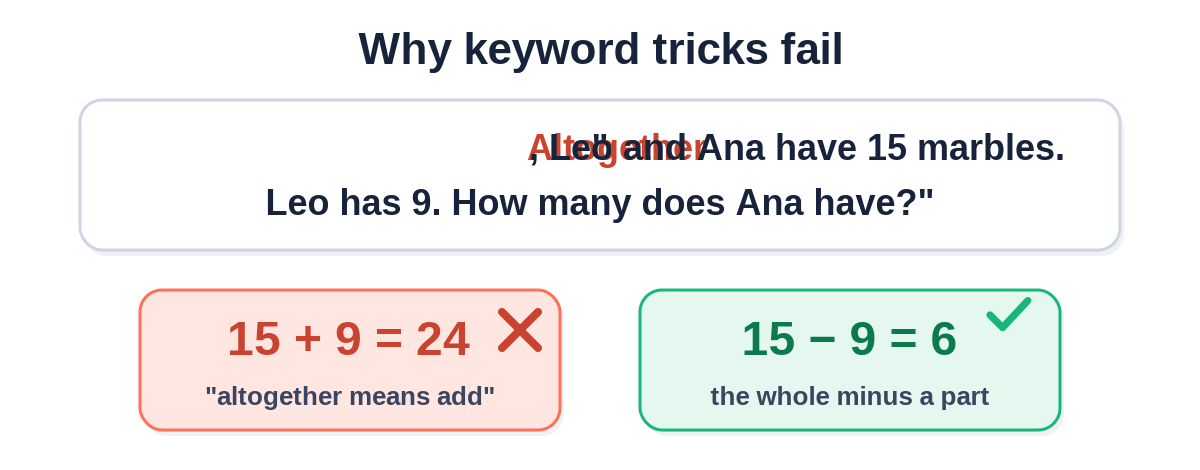
Many kids learn shortcuts that work for a while and then fail. "Altogether means add" works until a problem says "Altogether, Leo and Ana have 15 marbles. Leo has 9. How many does Ana have?" Then "altogether" leads straight to the wrong answer. Keyword tricks teach children to hunt for words instead of understanding the story.
School standards push past shortcuts on purpose. In first grade, the Common Core standards expect children to solve addition and subtraction stories with the unknown in every position: at the start, in the middle or at the end. By second grade, they solve one- and two-step problems within 100, and in third grade, two-step problems with all four operations.
A four-step plan

1. Read it, twice
Read the problem out loud together. Then read it again and ask, "What is the question asking us to find?" Have your child say it in their own words: "We need to find how many stickers Maya had before." If they can't say what they're looking for, they're not ready to compute yet.
2. Picture it
Draw it. For young children, little circles or tally marks are perfect. For older children, a bar model (also called a tape diagram) is one of the most useful tools in all of elementary math.
3. Solve it
Now write a number sentence that matches the picture, with a box or question mark for the unknown: ? + 5 = 12. Then solve it.
4. Check it
Put the answer back into the story. "If Maya had 7 stickers and got 5 more, does she have 12?" Yes. Also ask whether the answer makes sense: if the question asks how many vans are needed, the answer can't be 4.5.
Bar models: the picture that solves problems
A bar model shows the parts and the whole as rectangles. Here's the sticker problem:

Draw a long bar for the 12 stickers Maya has now. Split it into two parts: one part for the stickers she had at first (a question mark), and one part for the 5 she got. Now the picture tells you what to do: the whole is 12, one part is 5, so the other part is 12 − 5 = 7.
The magic of bar models is that they turn "which operation?" into a question you can see. If you know both parts and want the whole, add. If you know the whole and one part, subtract. If you have equal parts, multiply or divide. The picture at the top of this article shows exactly this problem.
The kinds of stories kids meet
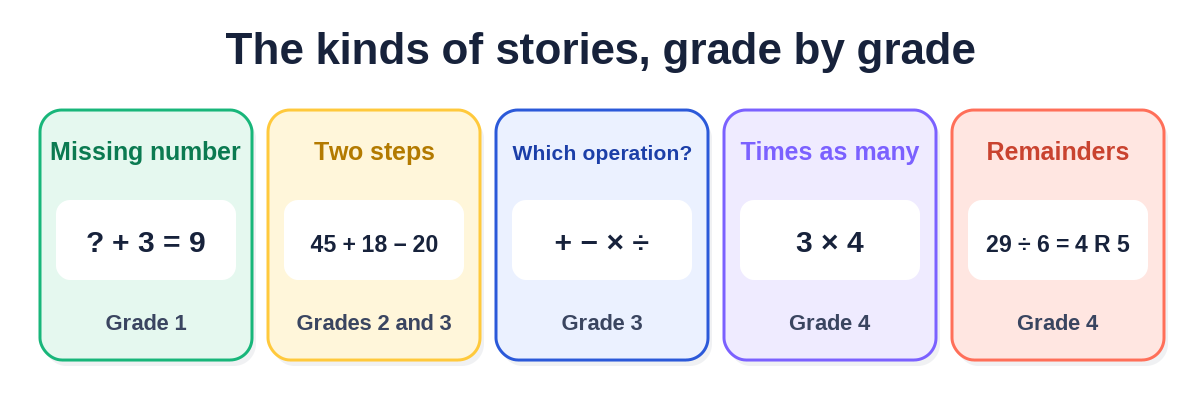
Missing-number stories (grade 1)
"Some birds were in a tree. 3 more came. Now there are 9. How many were there at first?" These are tricky because the action word ("came") suggests adding, but the answer comes from subtracting. Acting it out with toys helps enormously. Practice: missing number word problems.
Two-step stories (grades 2 and 3)
"Ben had 45 marbles. He won 18 more, then gave 20 to his sister. How many does he have now?" The most common mistake is stopping after the first step. Have your child write "Step 1" and "Step 2" on separate lines. Practice: two-step word problems and two-step problems with all operations.
"Which operation?" (grade 3)
Sometimes the best practice is to skip the computing entirely. Read a story and just decide: add, subtract, multiply or divide? It trains the thinking that word problems actually test. Practice: which operation?
Comparison and "times as many" (grade 4)
"Ana has 4 stamps. Ben has 3 times as many." A bar model makes this clear: draw one short bar for Ana and three of the same bars in a row for Ben. Practice: times as many word problems.
Remainder stories (grade 4)
"29 students, 6 per van. How many vans?" The division gives 4 R 5, but the answer is 5 vans, because nobody gets left behind. Practice: remainder word problems.
Small habits that make a big difference
- Make up stories together. Give your child a number sentence like 3 × 4 = 12 and ask them to invent a story for it. Writing problems builds understanding fast.
- Use real life. Cooking, shopping and sharing snacks are full of word problems. "We need 3 eggs for each batch and we're making 2 batches."
- Celebrate the picture, not just the answer. A child who draws a clear model and makes a small arithmetic slip is doing the hard part right.
- Keep it calm. Word problems take longer than fact practice. That's fine. Two or three problems done well beat ten rushed ones.
Free word problem practice, K–5
Every page below lets your child tap a light bulb for a hint, or "Show me how" for the steps, so they get help without being handed the answer.
- Word problems within 10Kindergarten
- Word problems within 20Grade 1
- Missing number word problemsGrade 1
- Two-step word problemsGrade 2
- Which operation?Grade 3
- Multiplication and division word problemsGrade 3
- Multi-step word problemsGrade 4
- Multi-step word problems with larger numbersGrade 5
Questions parents ask
Should I teach keywords like "altogether means add"?
It's better not to rely on them. Keywords work sometimes and mislead other times, and they teach children to skim instead of understand. Instead, ask what's happening in the story: are things being put together, taken away, compared or shared?
My child is a slow reader. Should I read the problems aloud?
Yes. Reading the problem aloud lets your child focus on the math thinking. You can gradually let them read more of it as their reading grows.
What if my child gets the right answer but can't explain it?
Ask them to draw it or act it out. Being able to explain is a sign of real understanding, and it becomes important in later grades when problems get longer.
How many word problems should we do at a time?
Fewer than you think. Three to five problems, done carefully with a picture and a check, are worth more than a full page done in a rush.
Sources and further reading
- Common Core State Standards, 1.OA.A.1: word problems within 20 with unknowns in all positions.
- Common Core State Standards, 2.OA.A.1: one- and two-step word problems within 100.
- Common Core State Standards, 3.OA.D.8: two-step word problems using the four operations.
- Common Core State Standards, 4.OA.A.2: multiplicative comparison word problems.


