
Here's a puzzle for the dinner table. 29 ÷ 6 is 4 with a remainder of 5. Now: 29 students are going on a field trip, and each van holds 6 students. How many vans do they need? If your child says "4 remainder 5", they've done the division perfectly and still got the problem wrong. The answer is 5 vans, because nobody gets left behind in the parking lot.
This is one of the most common stumbling blocks in fourth grade math, and one of the most important: it's where children learn that the math has to make sense in the real world. This guide shows how to teach it at home.
Why remainders need thinking, not just dividing
Through third grade, most division comes out even: 24 ÷ 6 = 4. In fourth grade, children start dividing numbers that don't split evenly, and they learn to write the leftover as a remainder. But a remainder on its own isn't an answer to a story. The Common Core standards ask fourth graders to solve multi-step word problems, including problems in which remainders must be interpreted. "Interpreted" is the key word: the child has to decide what the remainder means.
Three things a remainder can mean
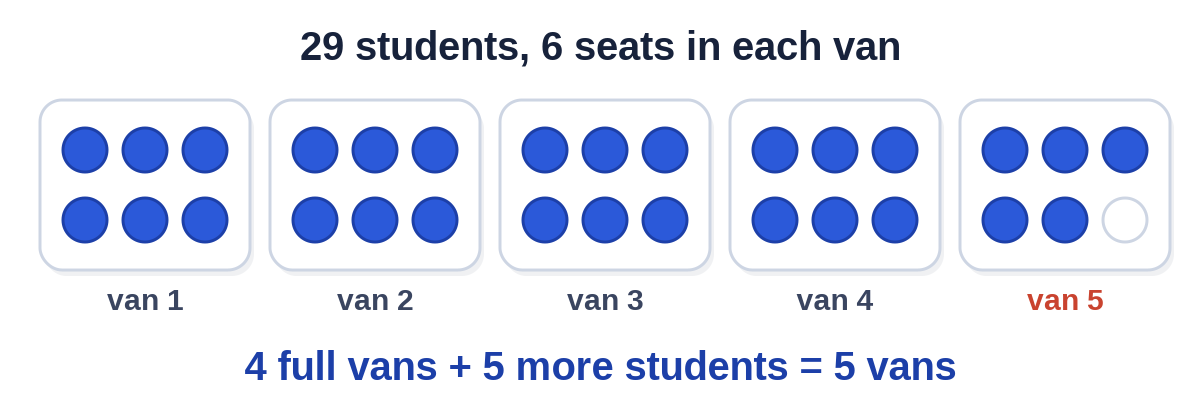
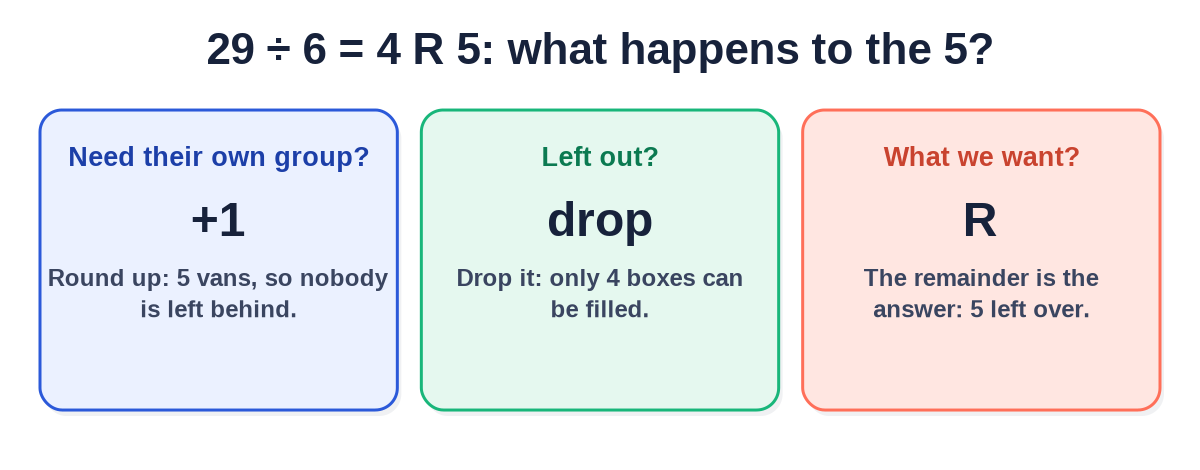
The same division, 29 ÷ 6 = 4 R 5, can answer three very different questions:
| The question asks... | What to do with the remainder | Answer |
|---|---|---|
| How many vans are needed for 29 students, 6 per van? | Round up: the extra students still need a van. | 5 vans |
| How many boxes can be filled with 29 muffins, 6 per box? | Drop it: the extra muffins can't fill a box. | 4 boxes |
| 29 stickers shared equally by 6 friends: how many are left over? | The remainder is the answer. | 5 stickers |
1. Round up: "how many are needed?"
When everything has to fit somewhere (people in vans, books on shelves, guests at tables), the leftover needs one more group. The answer is the quotient plus one.
2. Drop it: "how many full groups?"
When the question asks how many complete groups you can make (full boxes, whole outfits, teams of 5), the leftover doesn't count. The answer is just the quotient.
3. The remainder is the answer: "how many are left?"
Sometimes the question is about the leftovers themselves: how many stickers are left after sharing, or how many cookies are left for Mom.
How to teach it at home
Start with real objects
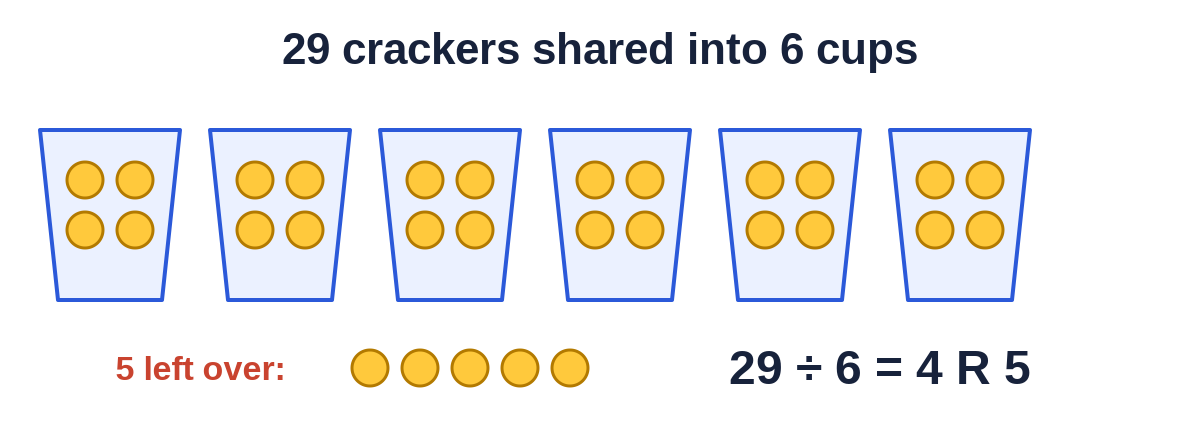
Get 29 small things (crackers, coins, LEGO bricks) and 6 cups. Share them out. Your child will see 4 in each cup with 5 left over. Then ask the three questions: "If each cup is a van, how many vans do we need? If each cup is a box we sell, how many full boxes do we have? How many are left over?" Same objects, three answers.
Draw it
For bigger numbers, a quick drawing works: rectangles for groups, dots for the leftovers. Seeing the 5 leftover students standing next to the last full van makes "we need another van" obvious.
Write the answer in a sentence
Ask your child to answer in words, not just numbers: "They need 5 vans." Writing the label forces them to think about what the number means. "4 R 5 vans" doesn't make sense as a sentence, and kids can hear that.
Check it
Multiply back: 4 vans × 6 = 24 students, plus the 5 left = 29. Then ask whether everyone is accounted for. If the answer was 4 vans, 5 students are still standing in the parking lot.
Practice problems to try
- A baker has 50 cupcakes and puts 8 in each box. How many boxes can she fill? (50 ÷ 8 = 6 R 2, so 6 full boxes.)
- 43 people are coming to a party. Each table seats 6. How many tables are needed? (43 ÷ 6 = 7 R 1, so 8 tables.)
- Leo shares 35 marbles equally among 4 friends. How many marbles are left over? (35 ÷ 4 = 8 R 3, so 3 marbles.)
- A rope is 50 feet long. How many 7-foot pieces can be cut from it? (50 ÷ 7 = 7 R 1, so 7 pieces.)
Our remainder word problems page mixes all three types, so your child has to read each question instead of following a pattern. Each one has a hint and a "Show me how" explanation.
What changes in fifth grade
In fifth grade, remainders grow up. Instead of writing "R 3", children start to see the leftover as part of a whole. If 4 friends share 9 pizzas equally, each friend gets 2 whole pizzas and there's 1 pizza left. But that pizza can be cut! Each friend gets another quarter, so each gets 2 1/4 pizzas.
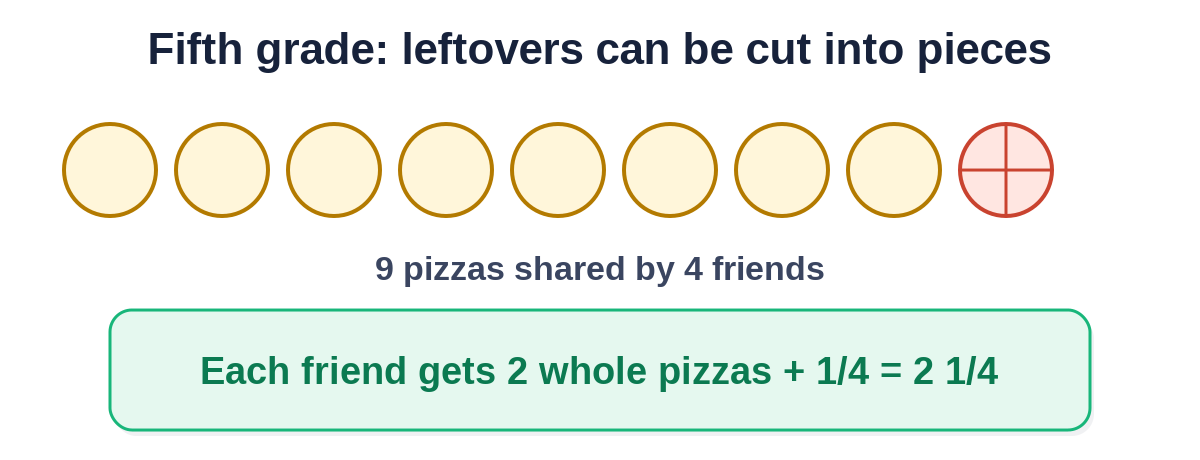
So now there's a fourth way to deal with a remainder: share it out as a fraction or a decimal. It works when the leftover can be split, like pizza, money or a length of ribbon. It doesn't work when it can't, like students or vans. The thinking is the same as in fourth grade: read the story, then decide what makes sense.
A quick test your child can use: "Can the leftover be cut into pieces?" If yes, a fraction or decimal might be the answer. If no, round up, drop it, or report it as the leftover.
Before remainders: solid division
If the division itself is still slow, interpreting remainders will feel overwhelming. Make sure your child knows their division facts and can divide with remainders before focusing on word problems.
- Division facts within 100Grade 3
- Multiplication and division word problemsGrade 3
- Long division with remaindersGrade 4
- Remainder word problemsGrade 4
- Multi-step word problemsGrade 4
- Division with two-digit divisorsGrade 5
Questions parents ask
When do children learn remainders?
Most children meet remainders in fourth grade, when they start dividing larger numbers that don't divide evenly. Interpreting remainders in word problems is part of the fourth grade standards.
Should my child write the remainder as "R 5" or as a fraction?
In fourth grade, "R 5" is standard. In fifth grade, children start to see remainders as fractions (29 ÷ 6 = 4 5/6) and decimals. For word problems, the important thing is the final answer in words.
What if a problem could go either way?
Good problems are clear, but real life isn't always. If your child argues that the leftover muffins could go in a half-full box, that's great thinking. Talk about what the question is really asking.
My child always rounds up. How do I break the habit?
Mix the three types together and have your child say, before solving, which type it is. Sorting problems by type, without computing, is a quick way to build the habit of reading the question.
Sources and further reading
- Common Core State Standards, 4.OA.A.3: multistep word problems, including problems in which remainders must be interpreted.


