
If your child can answer "what goes with 7 to make 10?" without counting, a lot of early math gets easier. Adding 8 + 5 turns into 8 + 2 + 3. Taking 7 away from 15 turns into 15 − 5 − 2. Teachers call these pairs number bonds to 10, "partners of 10" or "friends of 10," and they are one of the best uses of ten minutes a day in kindergarten and first grade. This guide walks you through teaching them at home, step by step, with pictures, games and free worksheets.
Why making 10 matters so much
Our whole number system is built on tens. Ten ones make a ten, ten tens make a hundred, and almost every mental math trick a child learns later leans on knowing how far a number is from the next ten. A child who knows that 8 needs 2 more to make 10 can add 8 + 5 in their head. Years later, the same child adds 38 + 5 by thinking "38 and 2 make 40, then 3 more is 43."
That's why school standards put so much weight on it. In the Common Core standards, which many states use or have adapted, kindergartners are expected to find the number that makes 10 for any number from 1 to 9. In first grade, "making ten" is named as a strategy for adding and subtracting within 20. And by the end of second grade, children are expected to know all sums of two one-digit numbers from memory. Make 10 is the first big step on that road.
The pairs that make 10
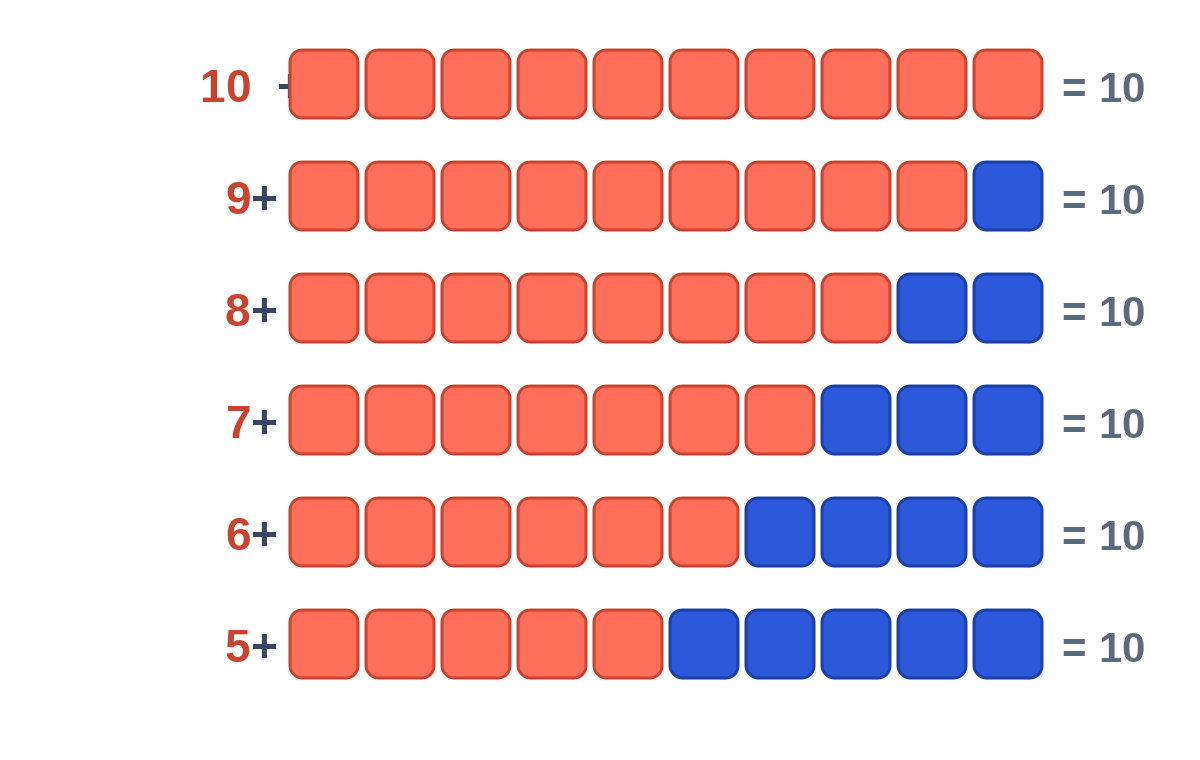
Here is the good news: there are only six pairs to learn.
- 0 and 10
- 1 and 9
- 2 and 8
- 3 and 7
- 4 and 6
- 5 and 5
Each pair works both ways, so 9 + 1 is the same as 1 + 9. Once your child sees that, eleven facts shrink to six.
Step 1: Start with fingers
Fingers are a ten-frame your child carries everywhere. Ask them to hold up 7 fingers, then ask how many fingers are still down. Three. Say it together as a sentence: "7 and 3 make 10." Then try 4, 9 and 5.
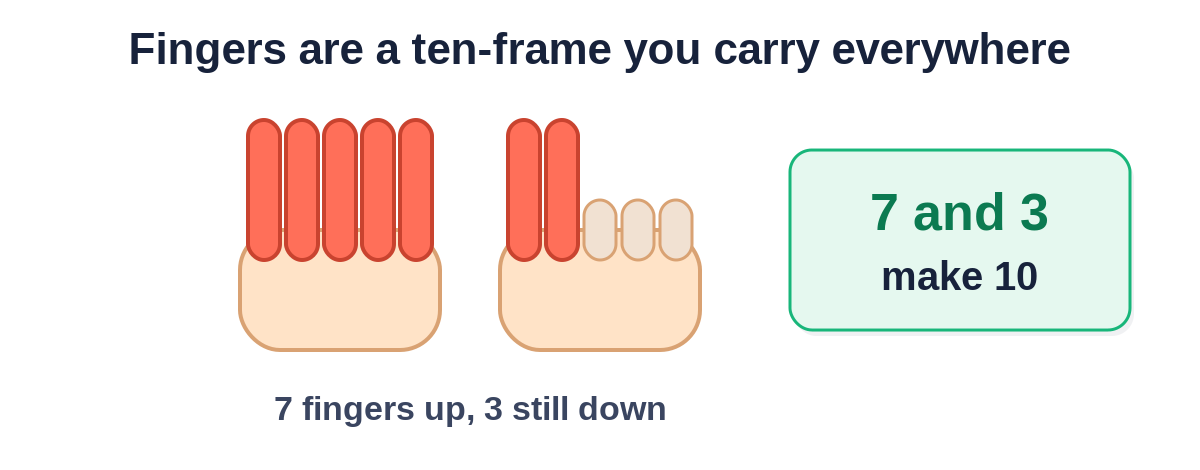
Some parents worry that fingers are a crutch. At this stage they're a tool, and a good one: your child is seeing the whole ten and both parts at the same time. As the pairs become familiar, the fingers fade on their own.
Step 2: Fill a ten-frame
A ten-frame is a box with two rows of five spaces. You can draw one on paper in a minute, or cut two cups off a dozen-egg carton. Put 6 beans, coins or buttons in the spaces and ask, "How many empty spaces?" Your child can see 4 without counting from 1, because a full row is 5.
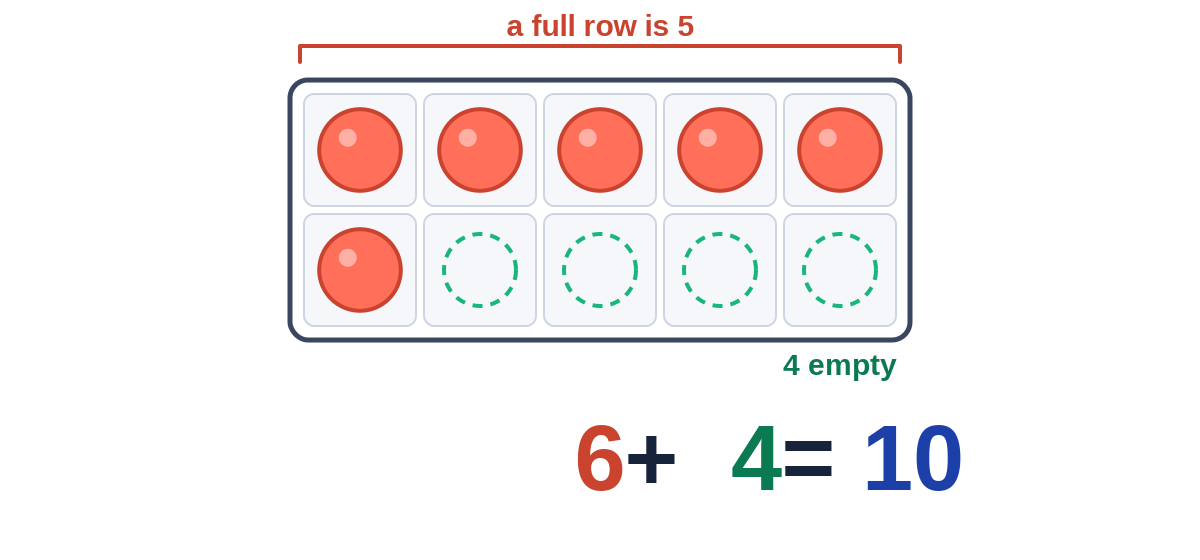
The rows of five matter. They let children see 7 as "5 and 2 more," which is the first taste of breaking numbers apart. Our Counting objects in ten frames worksheet practices exactly this kind of seeing.
Step 3: Draw number bonds
A number bond is a simple drawing: a circle with 10 in it on top, connected to two circles below for the two parts. Children fill in the missing part. It's the same idea as the ten-frame, just without the counters, and it shows the "whole and two parts" relationship that addition and subtraction both rest on.
Start with bonds where both parts are filled in and ask your child to check them ("Do 6 and 4 make 10?"). Then leave one part empty. When that's easy, our Add to 20 with number bonds practice uses the same picture with bigger numbers.
Step 4: Missing-number problems
Now move to number sentences with a blank:
- 6 + __ = 10
- __ + 3 = 10
- 10 = 4 + __
Mix up where the blank is. The last one, with the 10 on the left, is worth extra time: many children think the equal sign means "the answer comes next," when it really means "is the same as." Our free What makes 10? worksheet gives a new set every time, online or printed, with an answer key. Online, each problem has a hint and a "Show me how" button that walks through it step by step.
Step 5: Connect it to subtraction
When "3 and 7 make 10" feels automatic, show that 10 − 3 must be 7. It's the same three numbers. Take 10 counters, hide 3 under a cup and ask how many are left. Then flip it: hide 7.
The Subtracting from 10 sheet practices exactly that. Children who learn addition and subtraction as two views of the same pair have far less to memorize later, which is the idea behind fact families.
Step 6: Use make 10 to add past 10
This is the payoff. To add 8 + 5, your child asks, "What does 8 need to make 10?" It needs 2. Take the 2 out of the 5, which leaves 3. Now the problem is 10 + 3, which is 13.
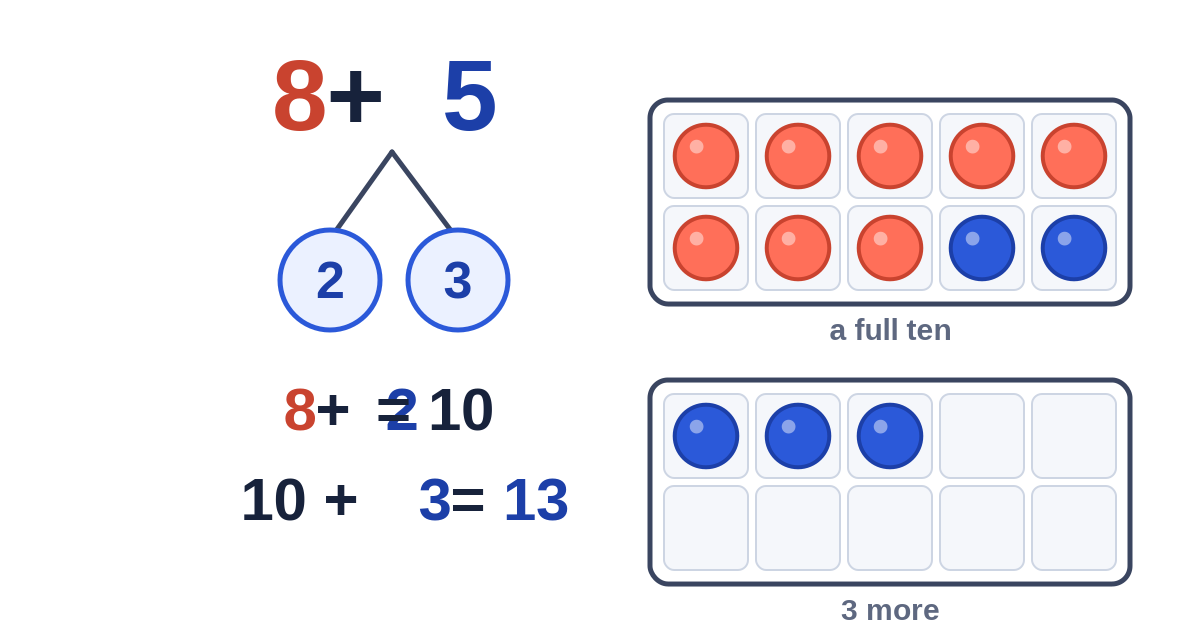
Subtraction works the same way in reverse. For 13 − 4, go down to 10 first: 13 − 3 = 10, then take away 1 more to get 9. Practice adding to the teens with Adding 10: teen numbers, then try Addition within 20, Subtraction within 20 and Subtract within 20 with number bonds.
Five quick make-10 games
Games keep practice short and fun, and they work in the car or the grocery line.
- Tens Go Fish. Use a deck of cards with the face cards and 10s removed. Instead of asking for a match, ask for your card's partner: "Do you have a 3?" if you're holding a 7.
- Hide the coins. Put 10 pennies on the table. While your child closes their eyes, hide some under a cup. They count what's left and say how many are hiding.
- Clap to 10. You clap 6 times, and your child claps the rest of the way to 10. Switch roles.
- Bottle bowling. Set up 10 empty water bottles. After each roll, say the pair out loud: "7 down, 3 standing. 7 and 3 make 10."
- Snack split. Count out 10 crackers onto two plates in different ways. How many ways can you find?
A two-week plan (10 minutes a day)
Here is one simple way to spread it out. If a step is easy, move on early; if it's hard, stay a day longer.
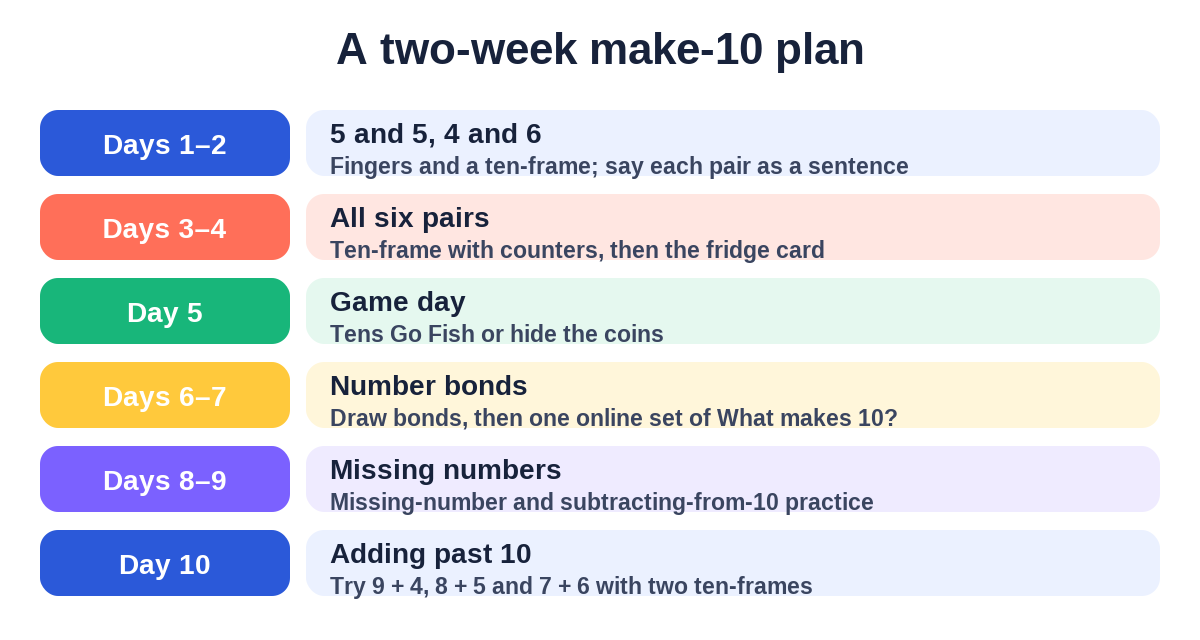
| Days | Focus | What to do |
|---|---|---|
| 1–2 | 5 and 5, 4 and 6 | Fingers and a ten-frame. Say each pair as a sentence. |
| 3–4 | All six pairs | Ten-frame with counters, then the fridge card. |
| 5 | Game day | Tens Go Fish or Hide the coins. |
| 6–7 | Number bonds | Draw bonds, then one set of What makes 10? online. |
| 8–9 | Missing numbers and subtraction | What makes 10? and Subtracting from 10, printed or online. |
| 10 | Adding past 10 | Try 9 + 4, 8 + 5 and 7 + 6 with two ten-frames. |
On weekends, skip the worksheets and play one game.
Common mistakes and how to fix them
- Counting from 1 every time. If your child counts all ten counters to find the empty spaces, cover the full row of five with your hand and ask how many are under it. Seeing five at a glance is the goal.
- Off-by-one answers. Saying 6 + 3 = 10 usually means they're guessing from a pattern. Go back to the ten-frame for that pair and let them see the gap.
- Stuck when the 10 is first. If 10 = 4 + __ causes confusion, read it aloud as "10 is the same as 4 and what?"
- Rushing. Accuracy first. Speed comes on its own once the pairs feel familiar, and there's no need for a timer (more on that in math practice without a timer).
How to know your child has it
You'll notice three things. They can tell you any partner of 10 in about three seconds without fingers. They use it without being asked, like saying "8 and 5 is 13, because 8 and 2 make 10." And they can explain it to someone else, maybe a younger sibling or a stuffed animal. When all three happen, move on.
What comes next
Make 10 opens a lot of doors. Next steps that build on it:
- Adding and subtracting doubles, like 6 + 6 and 7 + 7, the other big group of facts to know by heart.
- Adding three numbers, where spotting two numbers that make 10 makes the problem easy: 7 + 4 + 3 is 10 + 4.
- Tens and ones, which shows why ten is such a useful number.
- Two-digit addition in second grade, where 38 + 5 becomes 40 + 3.
Free make-10 worksheets
All of these are free. Each one makes a new set every time, works on a phone, tablet or computer, and prints with an answer key.
- What makes 10?Kindergarten
- Counting objects in ten framesKindergarten
- Subtracting from 10Kindergarten
- Addition within 10Kindergarten
- Add to 20 with number bondsGrade 1
- Addition within 20Grade 1
Questions parents ask
At what age should a child know number bonds to 10?
Most children start in kindergarten, around age 5 or 6, and know them well by the end of first grade. If your child is younger and curious, there's no harm in playing the games early. If they're older and still counting, a couple of weeks of short daily practice usually closes the gap.
Is it okay for my child to count on their fingers?
Yes. Fingers show the whole ten and both parts at once, which is exactly the idea you're teaching. Encourage them to "see" the fingers that are down instead of counting each one, and the habit fades naturally as the pairs become familiar.
What's the difference between number bonds and fact families?
They're two pictures of the same idea. A number bond shows a whole and its two parts. A fact family writes out every addition and subtraction fact those three numbers make, like 3 + 7 = 10, 7 + 3 = 10, 10 − 3 = 7 and 10 − 7 = 3.
How long should we practice each day?
Five to ten minutes is plenty. Stop while it's still going well, and come back tomorrow. Short, regular practice beats one long session every time.
Sources and further reading
- Common Core State Standards, K.OA.A.4: finding the number that makes 10.
- Common Core State Standards, 1.OA.C.6: adding and subtracting within 20, including making ten.
- Common Core State Standards, 2.OA.B.2: knowing sums of two one-digit numbers from memory.


